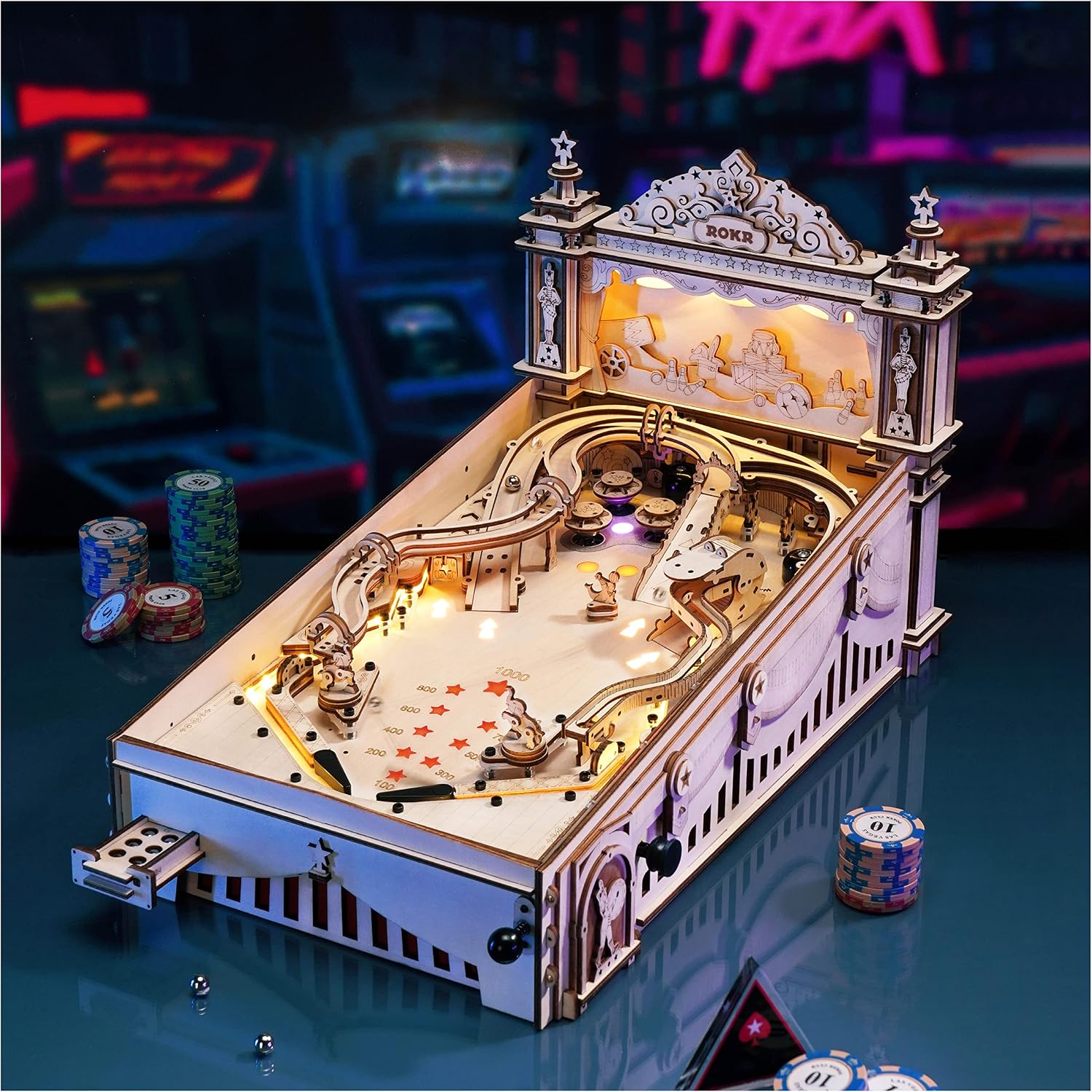
If you’ve ever watched a steel ball ricochet off rubber bumpers, slam a flipper (the paddle-shaped launcher at the bottom of the playfield — the part you control), and light up a string of targets in a cascade of sound and light, you already understand the core appeal. Pinball is physics made playable. What a lot of people don’t realize is that you can build one — or a scaled-down version of one — as a kit, the same way you’d assemble a model car or wire up an Arduino project. These DIY pinball kits range from cardboard tabletop toys that cost under $30 to fully programmable machines with real solenoids (electromagnets that fire the ball) and LED lighting. They’re increasingly popular in STEM education — Science, Technology, Engineering, and Math curricula — because a working pinball machine is basically an applied physics and electronics lesson you can play. This guide breaks down the landscape by age range, budget, and learning depth so you can make a confident decision, whether you’re buying for a curious ten-year-old or for yourself.
| EDITOR'S PICK[ROKR Miniature Pinball Machine-…](https://www.amazon.com/dp/B0C2DBQKCQ?tag=greenflower20-20) | Mid-tierThames & Kosmos Pinball Machine… | Budget pick[Smartivity DIY Pinball Machine…](https://www.amazon.com/dp/B08P5XGHJG?tag=greenflower20-20) | |
|---|---|---|---|
| Material | Wood | — | — |
| Age Range | 14+ | — | 8-14 |
| Build Type | 3D Wooden Puzzle | STEM Experiment | DIY Build |
| Award Winner | — | Toy of the Year Finalist | Global Award Winning |
| Includes Gumball | — | ✓ | — |
| Price | $158.99 | $35.93 | $34.99 |
| See on Amazon → | See on Amazon → | See on Amazon → |
How the Kit Market Actually Breaks Down
The DIY pinball kit category is messier than it looks from a search results page. Broadly, you’re looking at three distinct product tiers, and they solve different problems.
Tier 1: Cardboard and paper mechanism kits ($15–$45) These are gravity-and-elastic builds — no electricity, no soldering. Brands like Ugears and various puzzle-box manufacturers produce laser-cut wooden or cardboard pinball sets where the “plunger” (the spring-loaded rod that launches the ball) and bumpers are purely mechanical. Per Popular Mechanics’ 2025 STEM kit roundup, these kits tend to skew toward the 8–12 age range and are strong for teaching cause-and-effect mechanics and spatial reasoning. Assembly time averages two to five hours. The tradeoff: low replay value once built, and the educational ceiling is modest — you’re not learning anything about circuits here.
Tier 2: Electronics-forward kit machines ($50–$200) This is the productive middle ground. Kits in this range typically include a small playfield, a motorized or solenoid-assisted ball launcher, basic LED scoring displays, and some form of microcontroller (a small programmable chip — think of it as a tiny computer that runs the game logic). The Makey Makey-adjacent builds and the Pinbox 3000 customizable cardboard platform (designed explicitly for classroom use) live here, as does the more structured Strawbees Pinball construction set. Tilt Forums community threads from late 2025 consistently identify this tier as the highest satisfaction zone for teens and adults who want a genuine building experience without a six-month commitment.
Tier 3: Full-scale DIY machines and open-source platforms ($300–$2,000+) This is where the hobby overlaps with maker culture. Platforms like Mission Pinball Framework (MPF) — a free, open-source software system maintained by a volunteer community — allow builders to wire up real pinball hardware (actual Williams-style solenoids, playfield switches, full LED matrices) running on a Raspberry Pi or similar single-board computer. The FAST Pinball controller platform occupies a similar space but with commercial-grade hardware support. These projects are genuinely complex — expect a six-to-eighteen-month build cycle for a first machine — but the output is a real, playable machine that rivals entry-level commercial titles in functionality.
By the Numbers
| Tier | Typical Price | Core Skill Taught | Recommended Age | Build Time |
|---|---|---|---|---|
| Cardboard/Mechanical | $15–$45 | Physics, spatial reasoning | 8–12 | 2–5 hrs |
| Electronics/Microcontroller | $50–$200 | Circuits, basic coding, logic | 12–adult | 5–20 hrs |
| Full DIY / Open-Source Platform | $300–$2,000+ | Engineering, software, systems | 16–adult | 6–18 months |
The Kits Worth Serious Consideration
Pinbox 3000 (Cardboard Customizable, ~$40)
The Pinbox 3000 is the kit most frequently cited in classroom deployments. It ships as a flat-pack cardboard pinball machine chassis with pre-drilled holes, a working plunger, and enough blank space for students or kids to design their own playfield layouts. Reviewed favorably in Pinball Magazine Issue 14’s education segment, it’s notable because the point isn’t the finished product — it’s the iteration. You can add rubber bands, brass fasteners, foam bumpers, whatever you have on hand. Owners consistently report that the value is in the fifteen minutes after assembly, when a kid looks at a dead ball dropping straight through and starts problem-solving how to redirect it. That’s the lesson.
Tradeoff: it’s cardboard, so it won’t survive rough handling, and once a family has cycled through a few build variations, interest tends to drop off. Buy it as an experience, not a long-term piece.
Ugears Pinball Machine (Wooden Mechanical, ~$55–$75)
Ugears makes laser-cut wooden mechanical puzzle kits, and their pinball set is one of the more refined entries in the cardboard-adjacent category. No electricity required — the scoring mechanism is a rotating counter driven by the ball’s motion. Published reviews on maker community forums consistently note the build quality is noticeably higher than cardboard alternatives: the wooden gears and rubber-band-powered launcher hold up over repeated play. The downside is that it’s a fixed design — you’re building their machine, not designing your own. For a detail-oriented builder who wants a satisfying, displayable finished object, this is the pick. For a kid who wants to experiment with layouts, the Pinbox 3000 wins.
Strawbees Pinball STEM Kit (~$80–$120, typically sold through education distributors)
Strawbees is a construction system — straws and plastic connectors — that has a dedicated pinball module. What sets it apart is the curriculum integration: it ships with lesson plans aligned to engineering design cycle frameworks. The IFPA’s 2025 annual report on player registration trends noted an uptick in junior player engagement that correlates with increased school-based pinball exposure, and Strawbees is one of the platforms consistently named in that pipeline. For a parent buying for a classroom donation or a homeschool family who wants structured scaffolding, this is worth the premium over the Pinbox 3000. For a casual home purchase, it’s probably over-engineered for the price.
Mission Pinball Framework (MPF) + FAST Pinball Hardware (~$500–$1,500+ in parts)
This is the option for the serious adult builder or advanced teen with a mentor. MPF is free software; FAST Pinball sells controller hardware (the electronics that translate game logic into physical machine actions) with documentation that is genuinely accessible compared to rolling your own from scratch. Tilt Forums’ DIY build megathread, updated through early 2026, includes dozens of first-machine build logs using this combination. The consistent pattern in those logs: the people who finish are the ones who set a modest scope for their first build — a small playfield, three to five targets, simple rules — rather than trying to replicate a full-size commercial machine on the first attempt.
Budget honestly: parts add up faster than any single price point suggests. A rough first build — playfield, cabinet lumber, FAST controller, solenoids, LEDs, ball, glass — typically lands between $800 and $1,400 depending on whether you source used parts from the Pinside Marketplace (a community buy/sell forum). This is real money, but the output is a machine that, if built well, has genuine resale value and functions as a portfolio piece for anyone interested in electronics or game design professionally.
What Actually Teaches What
Here’s the tradeoff the product descriptions tend to obscure: not all of these kits teach the same thing, and the marketing around “STEM learning” is applied loosely enough to cover both a cardboard ramp and a fully coded solenoid driver.
If the goal is physics intuition — angles, momentum, energy transfer — mechanical kits do this well and do it immediately. A kid who builds a Ugears machine and then watches where the ball goes understands inclined planes and elastic potential energy in a way that no worksheet replicates.
If the goal is electronics and coding fundamentals, you need the microcontroller tier at minimum. The jump from mechanical to electronic is real, and there’s no shortcut. A kit that includes an Arduino or a Raspberry Pi and requires the builder to write even a few lines of code to modify game behavior is categorically different from one that doesn’t.
If the goal is genuine engineering practice — scoping a project, failing, debugging, iterating — the MPF/FAST full-build path is the only option that delivers it at depth. Pinball Magazine’s education coverage frames this correctly: the machine is almost beside the point. The process of making a solenoid fire reliably, writing the scoring logic, and debugging why the ball is draining in three seconds is the curriculum.
The Decision Rule
If you’re buying for a child under 12 who hasn’t shown strong interest in electronics yet, start with the Pinbox 3000 or Ugears. Under $75, no frustration barrier, immediate play. If interest is there, graduate up.
If you’re buying for a teenager or for yourself as an entry to the hobby and you want something that will hold your attention past the first weekend, the electronics-tier kits are the floor — anything below that will feel like it plateaus too fast.
If you’re an intermediate collector who already owns machines and you’re curious about the build side of the hobby, the MPF + FAST path is the honest answer. Budget $1,000–$1,500, set aside twelve months, find one build log on Tilt Forums that matches your target scope, and follow it. The community support is genuinely good. The IFPA’s growing junior engagement numbers suggest the pinball ecosystem is actively trying to cultivate builders, not just players — and the tooling has matured enough that a first machine is less of a moonshot than it was five years ago.
The kits at every tier have real value. The mistake is buying a tier-one kit expecting a tier-three experience, or avoiding the full build because it sounds intimidating without looking at what the community has already solved for you. Pick the tier that matches your actual goal, not the most impressive-sounding one.