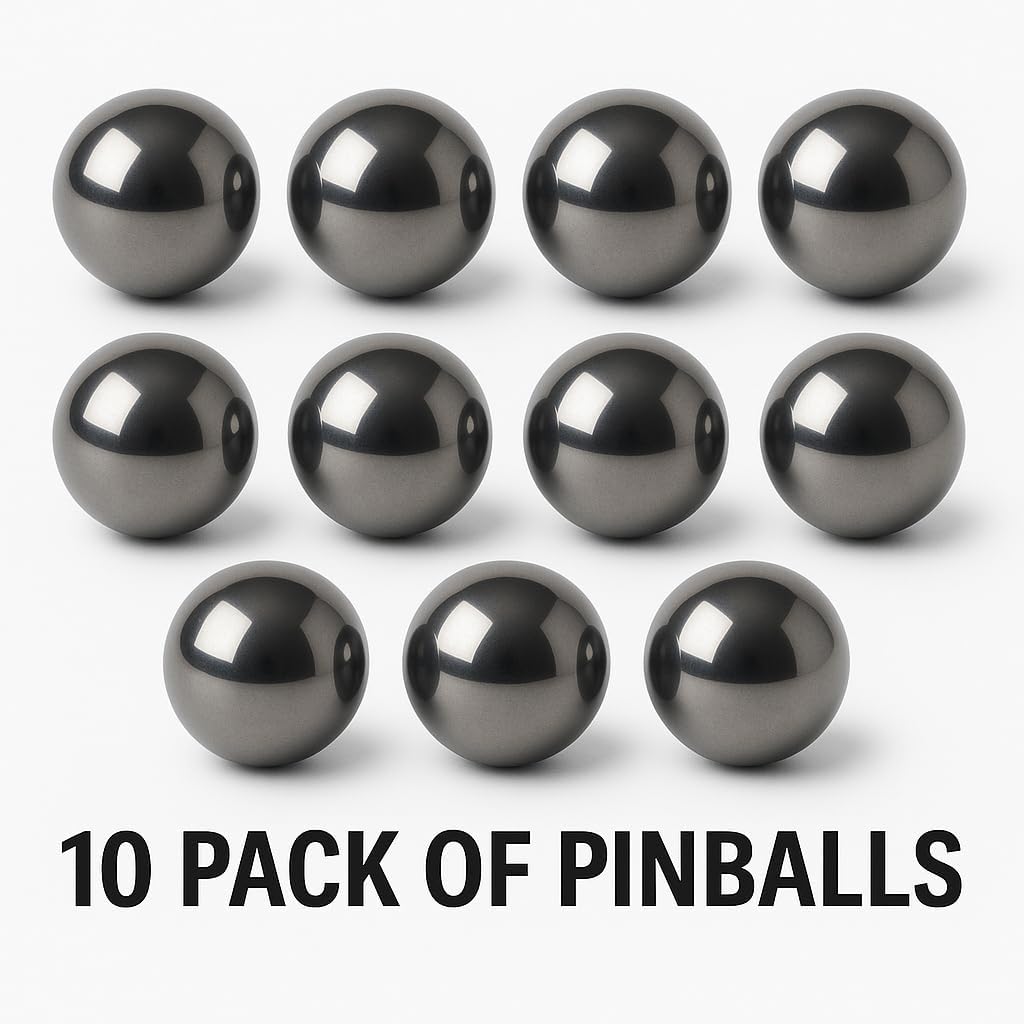
If you’ve ever looked inside a pinball machine — the sloped, glass-topped playfield (the playing surface where the ball rolls and targets get hit) — you’ve seen the ball: a small chrome-looking steel sphere roughly 1-1/16 inches in diameter. Most people assume a ball is a ball. You go to a parts supplier, order the cheapest pack, drop them in, and move on. That assumption turns out to be genuinely costly. The material grade, surface finish, and dimensional tolerance of a replacement pinball ball affect how fast your playfield wears, how consistently the machine plays, and — if you’re running multiple machines — how quickly your maintenance cycles stack up. This guide breaks down everything an intermediate collector or operator needs to know before ordering their next pack: what the specs actually mean, where the tradeoffs land, and exactly which decision rule to apply based on your situation.
What “Grade” and “Finish” Actually Mean — and Why They’re Different Problems
These two terms get conflated constantly in parts discussions, but they describe separate properties that matter in different ways.
Ball grade refers to dimensional precision and surface roundness — specifically how close to a perfect sphere a given ball is. The industry standard comes from ABMA (American Bearing Manufacturers Association) grade ratings. Grade 25, for example, means the ball deviates from a perfect sphere by no more than 25 millionths of an inch. Grade 100 means up to 100 millionths of an inch of deviation. Lower grade numbers = higher precision. Per Popular Mechanics’ reference coverage of steel ball manufacturing, precision grades are critical in bearing applications because even microscopic deviations create vibration and uneven wear — the same physics applies on a pinball playfield, just at lower speeds.
Why does this matter for pinball? A ball that’s slightly out-of-round will not roll true on a playfield. On a machine with precision-milled ramps — think Jersey Jack Pinball titles like Guns N’ Roses or a Chicago Gaming Medieval Madness Remake — off-round balls can cause ramp rejects that feel like misaimed shots when the real culprit is the ball itself. Competitive players on IFPA-sanctioned events (the International Federation of Pinball Arcades, the governing body for competitive pinball) notice this acutely: a Grade 25 ball in a tournament setting plays with a consistency a Grade 200 budget ball simply won’t match.
Surface finish, separately, is about what the outer surface of the ball is doing to your playfield every time it contacts it. Pinball playfields — especially on post-2010 Stern machines and virtually all Jersey Jack Pinball titles — use clearcoated ink printed over a wood substrate. That clearcoat is softer than steel. A rough, porous, or improperly finished ball surface acts like fine-grit sandpaper at high velocity. Over thousands of plays, this creates the dreaded “dimpling” phenomenon: small depressions and clear-coat erosion around high-traffic areas like pop bumpers (the cylindrical targets in the middle of the playfield that kick the ball away on contact) and slingshots (the triangular rubber-tipped bumpers near the flippers).
Tilt Forums threads going back several years show a consistent pattern in operator reports: machines running unbranded or off-spec balls from overseas suppliers develop visible playfield wear in 12–18 months of moderate play. Machines running polished, certified-grade balls from established pinball parts vendors show significantly less wear at the same play-count milestones. That’s not a coincidence — it’s physics.
The Finish Spectrum: Polished, Satin, and What to Avoid
Not all shiny balls are equal. Surface finish in pinball balls typically falls into three practical categories:
Mirror-polished (buffed): The highest quality finish. The surface is smooth enough to minimize abrasive contact with clearcoat. This is what most premium pinball-specific ball suppliers default to, and it’s what Stern Pinball specifies for factory balls in their machines. Owners on Tilt Forums consistently report that mirror-polished balls extend playfield life noticeably compared to satin or rough-finished alternatives, particularly on machines with exposed (non-hardcoated) playfields.
Satin or lightly tumbled: A mid-tier finish. Functionally fine for many applications, especially on older machines with already-worn clearcoat where the marginal damage is minimal. Less expensive, widely available, acceptable for a home machine getting casual play or a classic Williams or Bally title from the 1990s where playfield replacement is already part of long-term ownership math.
Unspecified / bulk industrial balls: This is where you need to apply skepticism. Steel balls manufactured for industrial bearing or ammunition applications may meet dimensional tolerances, but surface finish is not controlled for playfield contact. Owners who’ve sourced these via generic marketplaces report accelerated dimpling, occasional oxidation spotting (rust flecking, which scratches clearcoat severely), and inconsistent feel. Avoid these for any machine you care about preserving.
One additional consideration that Pinball News has noted in maintenance coverage: chrome-plated vs. carbon steel balls. Most premium pinball balls are carbon steel with a polished finish. Chrome-plated balls can look more impressive but are associated in some operator accounts with chipping over time — when chrome delaminates from the steel core, the exposed edge becomes a sharp abrasive. For playfield-safe replacement balls, carbon steel mirror-polish is the established baseline recommendation in the parts community.
By the Numbers
| Ball Type | Typical Grade | Finish | Approx. Retail (per ball) | Risk to Clearcoat |
|---|---|---|---|---|
| Premium pinball-specific (e.g., Pinball Life, Marco Specialties) | Grade 25–100 | Mirror polished | $1.50–$3.00 | Low |
| Generic “pinball ball” supplier | Grade 100–200 | Satin/tumbled | $0.50–$1.25 | Moderate |
| Industrial bulk / unspecified | Grade 200+ or unlisted | Uncontrolled | $0.25–$0.75 | High |
| Chrome-plated | Varies | Chrome over steel | $2.00–$4.00 | Moderate–High (chip risk) |
Prices reflect 2026 mid-year parts market across major pinball parts vendors.
Playfield Material Matters — Match Your Ball to Your Machine
This is the tradeoff most buyers miss entirely: the right ball for one machine isn’t necessarily the right ball for another.
Modern Stern Spike-2 and Spike-3 platforms (titles like Deadpool, Godzilla, Metallica Premium) ship with clearcoated playfields. Per Stern Pinball’s published service documentation, these playfields are designed around standard carbon steel balls with mirror-polished finish. Running anything rougher will accelerate clearcoat wear. Running anything with magnetic properties (some novelty balls) will interfere with the trough ball sensors — those are the sensors in the drain lane that track how many balls are in play.
Jersey Jack Pinball titles — including Guns N’ Roses LE, Pirates of the Caribbean, and Wonka — use hardcoated or UV-clearcoated playfields that are somewhat more durable. Operators report that JJP playfields are more forgiving of moderate-grade balls, but the high price of a JJP title ($9,000–$13,000+ at 2026 pricing) makes this a bad place to economize. If you’re protecting a $12,000 machine, spending an extra $1.50 per ball on Grade 25 mirror-polish is not a meaningful cost.
Classic Williams and Bally titles from the 1980s–90s (Addams Family, Medieval Madness original, Theatre of Magic) present a different calculation. Most of these machines have experienced 30+ years of play and clearcoat on their playfields is often partially worn or already touched-up. For a machine mid-restoration, ball grade is less critical than other variables. For a museum-grade original that you’re preserving untouched, the same premium-ball logic applies — you don’t want new abrasion on a 1992 playfield you can’t replace.
Spooky Pinball titles (Ultraman, Scooby-Doo, upcoming releases) use playfield constructions that vary by title. Per Spooky Pinball’s published build notes and community feedback aggregated on Tilt Forums, their clearcoat approach has been refined over successive titles. Check the specific title’s community documentation before defaulting to assumptions.
The Operator Math: Volume Changes the Equation
If you’re running machines commercially — arcade venue, barcade, family entertainment center — ball replacement volume changes the calculus.
At 6–10 machines with moderate to heavy daily play, you’re replacing balls every 3–6 months per machine depending on the title and traffic. That’s 20–40 balls per cycle across your fleet. At that scale, the $0.75–$1.50 per-ball difference between budget and premium balls represents real money: roughly $15–$60 per replacement cycle across a 10-machine route.
The correct offset calculation: a playfield swap on a modern Stern costs $400–$900 in parts alone, not counting labor. A single playfield replacement you delay or avoid by running better balls pays back the premium ball cost dozens of times over. Operators on Tilt Forums who’ve tracked this explicitly note that playfield wear acceleration is nonlinear — the first year of rough-ball use does proportionally more damage than subsequent years because the clearcoat is being stripped from an intact surface.
If you’re operating commercially, the ROI on premium balls is unambiguous. The math doesn’t require much scrutiny beyond that.
Decision Rules: If X, Then Y
Here’s how to apply everything above based on where you actually sit:
If you own a single home machine and play casually (2–5 hours/week): Any pinball-specific ball from an established vendor (Marco Specialties, Pinball Life, or similar) in a satin or polished finish will serve you fine. Don’t buy industrial bulk. Don’t overthink Grade 25 vs. Grade 100 at this volume.
If you own 3+ machines in a dedicated game room and care about long-term playfield condition: Standardize on Grade 25–100, mirror-polished carbon steel from a verified pinball parts vendor. The consistency bonus also makes your machines play more predictably — relevant if you use your game room for practice or host competitive players.
If you own a premium title (JJP, Spooky limited run, CGC remake) that you’re holding as a collectible or investment: Use only Grade 25 mirror-polished balls. The playfield is a primary driver of machine value at resale. Per aggregated listings and price tracking in the collector market as of mid-2026, premium-grade titles with clean, unworn playfields command 15–25% premiums over equivalent titles with visible dimpling. A $3 ball decision is protecting thousands in resale headroom.
If you operate commercially: Calculate your fleet-wide replacement cycle, factor in the playfield replacement cost you’re deferring, and buy premium balls in bulk from your parts vendor. The per-unit cost at quantity is often below $2/ball even for Grade 25 polished stock. This is not a place to economize.
If you’re prepping a machine for IFPA-sanctioned tournament play: Grade 25, mirror-polished, freshly installed ball. Ball consistency is part of creating fair play conditions, and experienced tournament players notice grade variance in a way casual players don’t.
The ball is the only part of a pinball machine in constant contact with everything else. Treating it as an afterthought is how expensive playfield repairs sneak up on collectors and operators alike. Spend the extra dollar. The playfield will thank you 50,000 plays from now.