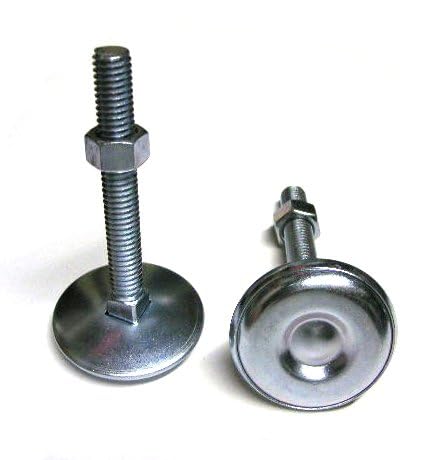
A pinball machine is heavier than it looks — most full-size games weigh between 225 and 300 pounds — and all of that weight rides on four steel legs bolted to a wooden cabinet. Those legs are adjustable in height so you can tilt the playfield (the slanted surface where the ball rolls and all the action happens) to the correct angle, which affects how fast the ball moves and how reliably the flippers — the two paddles you control to bat the ball around — can redirect it. If the machine isn’t level side-to-side, or isn’t pitched at the right angle front-to-back, every shot feels slightly wrong and the game wears unevenly. This guide covers every piece of hardware involved in getting that geometry right: leg bolts, levelers, floor protectors, and the small parts that make the difference between a machine that stays put and one that slowly creeps across your floor. If you already know what a lockdown bar is, you’re in the right place — the rest of this article runs at practitioner depth.
Why Leveling Is a Mechanical Decision, Not Just Preference
There’s a persistent assumption among new collectors that playfield pitch is mostly about feel — personal taste. That’s partially true, but the mechanical case is stronger than most people realize.
Stern Pinball’s operator manuals (available directly from stern-pinball.com) spec the standard playfield pitch at 6.5 degrees for modern Spike-2 platform titles. Older Williams and Bally electromechanical and solid-state games from the late 1970s through the mid-1990s were typically set between 6.0 and 7.0 degrees, a range confirmed by manufacturing records archived at the Internet Pinball Database (ipdb.org). Running outside that band isn’t neutral:
- Too shallow (under 5.5°): The ball moves slowly, drains less often, but return shots to the upper playfield become sluggish. Flippers have to work harder and the coils run warmer over long sessions.
- Too steep (over 7.5°): Ball speed increases dramatically, drains accelerate, and the machine can feel brutal on a home game where casual players are your audience. Flipper return springs also wear faster.
- Side-to-side unlevel: Even a quarter-inch of tilt creates a persistent bias — the ball consistently favors one drain lane, wearing that lane’s rubber and switch more than the other, and making certain shots systematically easier or harder than the designer intended.
The hardware you choose determines how precisely and how durably you hold that geometry. That’s the decision frame for everything below.
The Four Hardware Categories and What Each One Does
1. Leg Bolts and Leg Plates
Every full-size pinball cabinet ships with a leg plate — a heavy steel bracket mounted to the cabinet’s bottom corners — and four carriage bolts per plate that hold the leg in position. On most Stern and Chicago Gaming titles from the last decade, these are 3/8-16 thread, typically 1.5 inches long, but earlier Williams and Bally cabinets used a mix of bolt patterns depending on production year. Before you buy replacements, verify your specific cabinet’s pattern against the IPDB machine record or your manual.
The failure mode here is gradual: bolts back out under vibration, the leg develops micro-movement, and the cabinet rocks. Community threads on Tilt Forums document this consistently as a slow-creep problem that owners notice after six to twelve months of regular play — the machine was level at setup, and then it simply isn’t anymore.
The fix: Nylon-insert locking nuts (often called Nylock nuts) on every leg bolt. They’re inexpensive, prevent vibration back-out, and are the single highest-leverage change for long-term stability. Stainless hardware is worth the marginal premium in a basement environment where humidity cycles.
2. Leg Levelers (Adjustable Feet)
The legs on most machines ship with a fixed-height foot — a flat steel pad that contacts the floor. Adjustable leg levelers thread into the bottom of the leg (or replace the existing foot) and give you ¾ inch to 1.5 inches of height adjustment per leg via a threaded stud. That’s your primary pitch control.
By the numbers:
- Standard leg height on Stern Spike-2 cabinet: approximately 26.5 inches (rear) with recommended pitch achieved via front-leg adjustment
- Playfield pitch range most operators use: 6.0°–6.5°
- Height change per full rotation of a standard 1/2-13 leveling foot: approximately 1/16 inch
Aftermarket rubber-tipped levelers add floor protection and slight vibration damping. Operators in long-run reviews on Pinball News consistently note that rubber tips reduce the high-frequency rattle that travels into hard floors — a meaningful quality-of-life factor in a finished basement or room over living space.
Tradeoff to name explicitly: Leveling feet with a wide base plate (sometimes called “mushroom” feet) distribute load more broadly on soft flooring — important on LVP (luxury vinyl plank) or hardwood, where standard feet can indent the floor over time. If you’re on concrete with rubber matting, the base plate size matters less.
3. Floor Protectors and Anti-Slide Pads
A machine that’s level when you set it up will stay level only if it can’t migrate. On smooth floors — sealed concrete, hardwood, LVP — pinball machines walk. Solenoid fire and flipper action create rhythmic micro-vibrations that slowly propel the cabinet forward. Pinball News setup guides note this is especially pronounced on games with strong shaker motors (a mechanical device inside the cabinet that produces whole-body vibration for effect), such as Stern’s Deadpool or Iron Maiden Premium/LE.
Your options:
| Floor Type | Recommended Solution | Notes |
|---|---|---|
| Sealed concrete | Rubber furniture cups or adhesive grip pads | Inexpensive; check for incompatibility with rubber flooring |
| Hardwood / LVP | Wide felt-base cups or silicone pads | Prevents both sliding and indentation |
| Carpet | Standard feet often sufficient | Fiber provides natural grip; shag or thick pile can cause instability instead |
| Rubber gym matting | Interlocking tile adds compliance; minimal sliding | Verify matting doesn’t compress unevenly under leg placement |
The community consensus on Tilt Forums — across multiple threads covering home installations — is that silicone leg cups outperform felt pads on hard floors because they grip without leaving adhesive residue and don’t compress permanently under load the way felt does.
4. The Digital Level (Not Hardware, but Non-Negotiable)
Every hardware decision in this guide requires a reference measurement. A bubble level from a hardware store is technically functional but introduces enough parallax error that you’ll be chasing a half-degree back and forth for an hour. A digital angle gauge — the kind used for table saw setup — gives you a reading to a tenth of a degree, which is the resolution you actually need.
Published setup guides from Stern Pinball recommend placing the level on the playfield glass (the transparent panel that covers the playfield), not on the cabinet exterior, because the cabinet can be slightly twisted relative to the playfield plane. Measure at the glass, adjust via the front legs, recheck, repeat. The process takes about fifteen minutes done correctly.
Parts You Should Have on the Shelf Before You Start
If you’re setting up a newly acquired machine or re-leveling after a move, here’s the working parts list based on aggregated owner recommendations across the Tilt Forums community and Pinball News hardware coverage:
- Nylon-insert locking nuts in 3/8-16 (for most post-2000 Stern/Williams/Bally cabinets) — buy a pack of 20, you’ll use them elsewhere on the machine eventually
- Replacement leg levelers — rubber-tipped, 1/2-13 thread is the most common modern spec; confirm against your manual before ordering
- Digital angle gauge — any model accurate to 0.1° works; this is a one-time purchase that pays off across every machine you’ll ever own
- Silicone leg cups — four per machine; sized to your leg diameter (1.5 inches is standard on most full-size games)
- Threadlocker (medium-strength) — for any bolt that goes through wood rather than a captured nut; prevents back-out without making future service impossible
What you don’t need: Dedicated pinball-branded leveling kits at significant markup. The hardware is standard industrial/furniture fastener spec. The premium is in knowing which spec you need, not in buying a branded package.
Leg Hardware Across Machine Tiers: Does Price Change the Equation?
Short answer: yes, in one specific way.
Entry-level used games — a 1990s Williams or Bally in the $1,500–$2,500 range — often arrive with worn or damaged leg hardware. The leg bolts may be stripped, the feet corroded, or the leg plates slightly bent from prior moves. Budget $30–$60 for a complete hardware refresh on any machine purchased used. This isn’t optional maintenance — damaged leg hardware means you can’t hold calibration regardless of how carefully you set it.
Mid-tier games — Stern Pro and Premium titles in the $5,500–$8,500 range, typically purchased new or near-new — arrive with correct hardware, but the default feet are bare steel. Aftermarket levelers and floor cups are still the right upgrade, particularly if your floor is anything other than unfinished concrete.
Premium and collector titles — Jersey Jack Pinball games, Spooky Pinball boutique releases, CGC remakes — warrant stainless hardware throughout. According to Jersey Jack Pinball’s published documentation (available at jerseyjackpinball.com), their cabinets use heavy-gauge leg plates that accept standard leveling feet. The larger cabinet footprint of a JJP title (Guns N’ Roses LE, for instance, is noticeably deeper than a standard Stern cabinet) means floor cup placement needs to be verified rather than assumed.
The Decision Rule
If you’re looking at a single-machine home setup on a hard floor with no plans to move the game frequently:
Nylon-insert locking nuts + rubber-tipped leveling feet + silicone floor cups + digital angle gauge. That’s the complete kit. Budget under $80, installed in under an hour, and the machine holds calibration for years.
If you’re building out a multi-machine game room on LVP or hardwood, or if you have a shaker-motor game in the lineup:
Add wide-base leveler feet on every machine and verify floor indentation monthly for the first ninety days. Vinyl and hardwood respond differently to sustained point loads, and early adjustment prevents permanent damage.
If you’re buying used and the leg hardware is visibly worn or the cabinet rocks before you even start adjusting:
Full hardware refresh before you do anything else. You cannot reliably level a machine on failed hardware — you’re chasing a moving target. Replace first, then calibrate.
The geometry is everything. Get it right once with the right parts, and you won’t touch it again until the next move.